

12 Best Interactive Cat Toys to Keep Your Cat Entertained
Your cat sleeps 16 hours a day, then turns the other 8 into a demolition derby through your living room. That burst of 2 a.m. zoomies, the shredded toilet paper, the swatted-off coffee mug: it's boredom talking, not bad behavior. An interactive cat toy gives that energy somewhere to go, and it can turn a restless, destructive cat into a calmer, happier one within days.
If you're hunting for the best interactive cat toy for your indoor cat, you want something that actually holds their attention past the first five minutes, not another toy gathering dust under the couch. The right pick taps into real hunting instincts: stalking, pouncing, chasing. That's what keeps cats engaged, especially ones who spend all day indoors without much else to chase, which is why toys that keep bored indoor cats active matter so much.
We've tested and researched dozens of options to find picks that solve the boredom problem for good. Below you'll find 12 interactive cat toys for indoor cats, from motion-activated wands to puzzle feeders and app-controlled gadgets, each chosen for durability, real engagement, and value. Whether your cat is a couch potato who needs coaxing or a hunter who needs an outlet, there's a toy on this list built for them.
1. Pet Shop Hero interactive cat toy
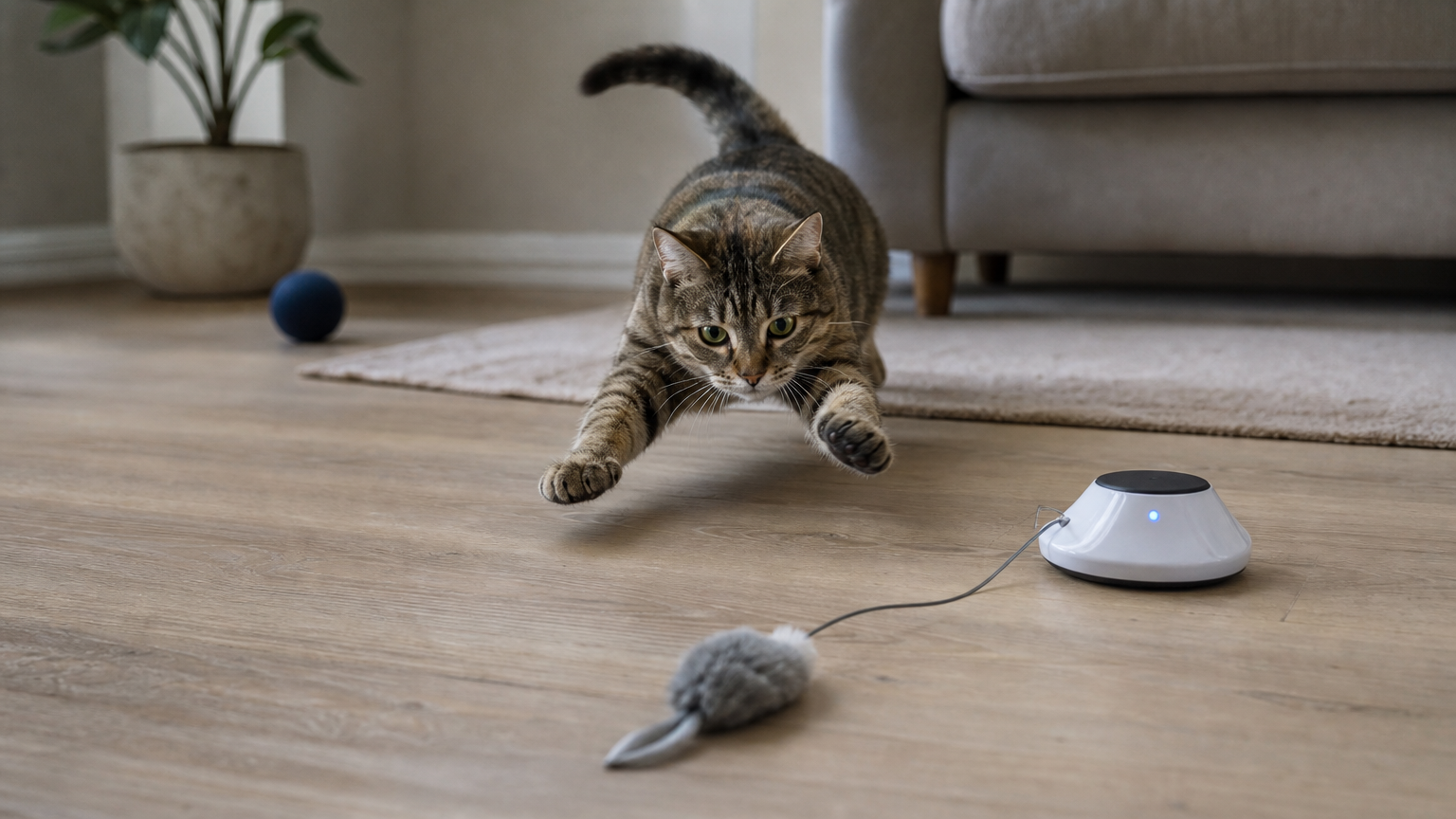
Pet Shop Hero built its own line of interactive cat toys after noticing how many customers were returning generic teasers that broke down or stopped holding their cat's attention after a week. The result is a toy designed around three things cats actually respond to: unpredictable movement, textures that mimic prey, and a build sturdy enough to survive daily pouncing. It's the pick we recommend first when someone asks us for the best interactive toy cat owners keep coming back to, because it's engineered specifically to solve the boredom problem rather than just look good in a product photo.
How it works
The toy combines a motorized, randomized movement pattern with a lightweight prey-like attachment that darts, pauses, and changes direction the way real prey would. There's no fixed loop for your cat to memorize and lose interest in within minutes. You can run it in supervised play sessions with the wand attachment, or switch to the automatic mode so it activates on its own for solo play when you're leaving your cat home alone on a work day. Battery life covers several days of intermittent use, and the housing is built to shrug off claws and teeth, so it's not a toy you'll be replacing every month.
Why cats love it
Cats are wired to stalk, chase, and pounce, and this toy triggers all three in sequence rather than just one repetitive motion. The unpredictable movement pattern is the key detail here.
A toy your cat can predict is a toy your cat will ignore within a week.
Owners who've switched from a basic string toy or a static plush report their cats engaging for full 15 to 20 minute sessions instead of the usual two-minute burst of interest. That's a meaningful jump for anyone trying to burn off a bored cat's energy before bedtime.
Best for
This toy suits indoor cats who show classic boredom behaviors: knocking things off counters, pouncing on your feet at 3 a.m., or shredding the sofa and anything else left within reach. It also works well for multi-cat households, since the randomized movement gives more than one cat something to chase without them fighting over a single fixed target. If you've tried a laser pointer or a basic feather wand and your cat lost interest after day one, this is the upgrade worth making.
Price range
You'll find the Pet Shop Hero interactive cat toy priced in the affordable mid-range for automated cat toys, and it ships with free standard delivery to the USA, UK, and Europe. Every order comes backed by Pet Shop Hero's 90-day return policy, and you'll find the full shipping and returns answers listed out, so if your cat genuinely turns up its nose at it, you're not stuck with an unused toy in a drawer.
2. Automatic laser cat toy
An automatic laser cat toy projects a moving red dot across the floor and walls, cycling through random patterns so your cat never quite knows where it's headed next. It's one of the most recognizable interactive cat toys on the market, and for good reason: the chase instinct kicks in the moment that dot starts moving, no training required.
How it works
Most models sit on the floor or mount to a wall and rotate the laser through preset or randomized paths, usually on a timer that runs for 15 to 30 minutes before shutting off automatically. Some let you adjust speed and pattern width, which matters if you've got a senior cat who can't lunge the way a kitten can. Look for one with an auto-shutoff feature, since a laser left running unsupervised for hours isn't doing your cat's eyes or your electric bill any favors.
Why cats love it
The dot never behaves like anything a cat has caught before, and that's exactly the appeal. It darts, vanishes, reappears, and never gets "caught," which keeps the chase instinct firing longer than most physical toys manage.
A cat that never catches the prey never gets bored of chasing it.
Because there's no physical toy to grip or bite, though, pair it with a real target every so often so your cat gets the satisfaction of an actual catch, which is the golden rule of laser pointer play.
Best for
High-energy cats and kittens who need a cardio outlet benefit most, and it's a solid option for owners short on time who still want their cat moving.
Price range
Basic laser toys run cheap, typically under $20, while automatic rotating models with timers land closer to $25 to $40.
3. Motion-activated feather teaser
A motion-activated feather teaser senses when your cat approaches and springs to life, twitching or spinning a feathered attachment to mimic a bird trying to escape. It's a step up from a plain feather wand because it does the work of triggering the chase without you standing there holding it, which makes it one of the better interactive cat toys for solo play during the day.
How it works
A built-in motion sensor detects nearby movement and kicks the toy into action, usually rotating or bobbing a feather cluster on a flexible arm. Most units power down after a stretch of inactivity to save the battery, then reactivate the moment your cat wanders back over. Some models sit on a weighted base so a determined swipe won't send the whole thing skidding across the kitchen floor.
Why cats love it
The sudden burst of movement mimics a bird startled into flight, and that trigger taps straight into predatory instinct. Cats don't need to learn how to play with it; the sensor does the inviting for them.
A toy that reacts to your cat, instead of waiting to be operated, gets played with far more often.
The feather texture also gives cats something satisfying to bite and grip, which a laser dot can't offer.
Best for
This one suits cats who are naturally curious but not always confident enough to approach a stationary toy first. It's also a good fit for owners who want a cat toy interactive enough to hold attention without needing to be switched on manually every time.
Price range
Motion-activated feather teasers typically run $15 to $35, depending on build quality and whether the feather attachments are replaceable once your cat inevitably shreds them.
4. Treat-dispensing puzzle toy
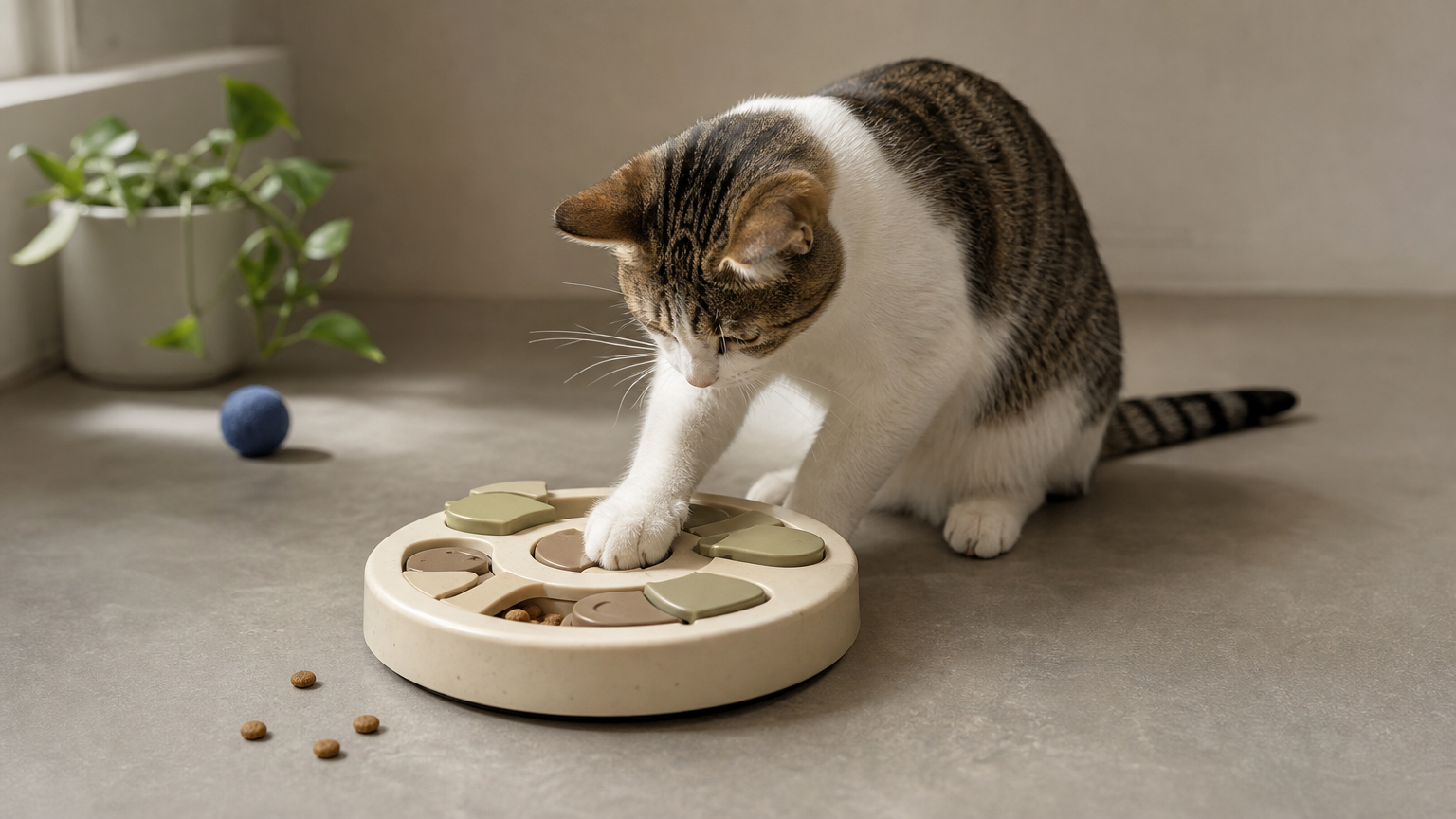
A treat-dispensing puzzle toy forces your cat to work for its food, using paws, nose, or teeth to figure out how to release kibble or small treats hidden inside. Unlike most interactive cat toys on this list, the reward here is edible, which taps into foraging instinct rather than just the chase.
How it works
Typically the toy consists of a treat-filled chamber with sliding panels, spinning discs, or small holes that only release food when your cat noses, paws, or rolls it the right way. Difficulty ranges from beginner models with wide openings to advanced puzzle boards with multiple compartments and hidden levers. Most owners start easy and increase difficulty gradually, since a cat that can't figure out the puzzle at all just walks away frustrated.
Why cats love it
Food is the ultimate motivator, and a puzzle that makes a cat work for it mimics the effort of hunting prey in the wild. Slow feeding also curbs the gulp-and-vomit cycle common with cats who eat too fast from a regular bowl, the same reason slow-feeder bowls exist.
A hungry cat will solve a puzzle a bored cat won't bother with.
Owners consistently report calmer cats after switching from a free-fed bowl to a puzzle feeder, especially in single-cat households where mealtime used to be the only excitement of the day.
Best for
This toy suits overweight or food-motivated cats who need slower, more deliberate eating, and it's one of the better interactive toys for cat owners managing anxiety or boredom-driven overeating. It's also a smart pick for cats left alone for long stretches, since the mental effort tires them out as much as physical play would.
Price range
Simple puzzle feeders start around $10 to $15, while multi-level puzzle boards with adjustable difficulty run $20 to $35.
5. Robotic mouse toy
A robotic mouse toy skitters across the floor on its own, mimicking the erratic scurry of a real rodent instead of the smooth arcs you get from a laser dot. Plenty of owners consider it the best interactive toy cat shoppers can grab for a cat who's more mouser than bird-watcher, since the low, ground-hugging movement matches exactly what a real prey animal would do.
How it works
Internal sensors detect obstacles like walls or furniture legs and redirect the toy's path, so it never gets stuck bumping into the same corner over and over. Most models run on a rechargeable battery and switch directions randomly, sometimes darting under a couch or behind a chair leg before reappearing. A soft fur or fabric shell covers the motor housing, which lets your cat mouth and carry it around the way she would an actual catch.
Why cats love it
Ground-level movement plays to a cat's natural hunting posture better than anything airborne or projected onto a wall. She can crouch, stalk, and pounce exactly like she would outdoors.
A toy that moves like prey gets treated like prey.
Because the mouse can be carried, batted, and even "killed," it satisfies the full hunt sequence in a way a laser dot never manages.
Best for
This pick suits cats who ignore anything airborne but light up the second something skitters across the floor, which is the heart of the electric mouse toys versus feather wands question. It's also a solid choice for apartment cats with limited vertical space, since the play happens entirely at floor level, though a cat tree or tower can add the height they're missing.
Price range
Basic robotic mice start around $12 to $18, while sturdier, sensor-equipped versions with rechargeable batteries run $20 to $30.
6. Interactive wand toy
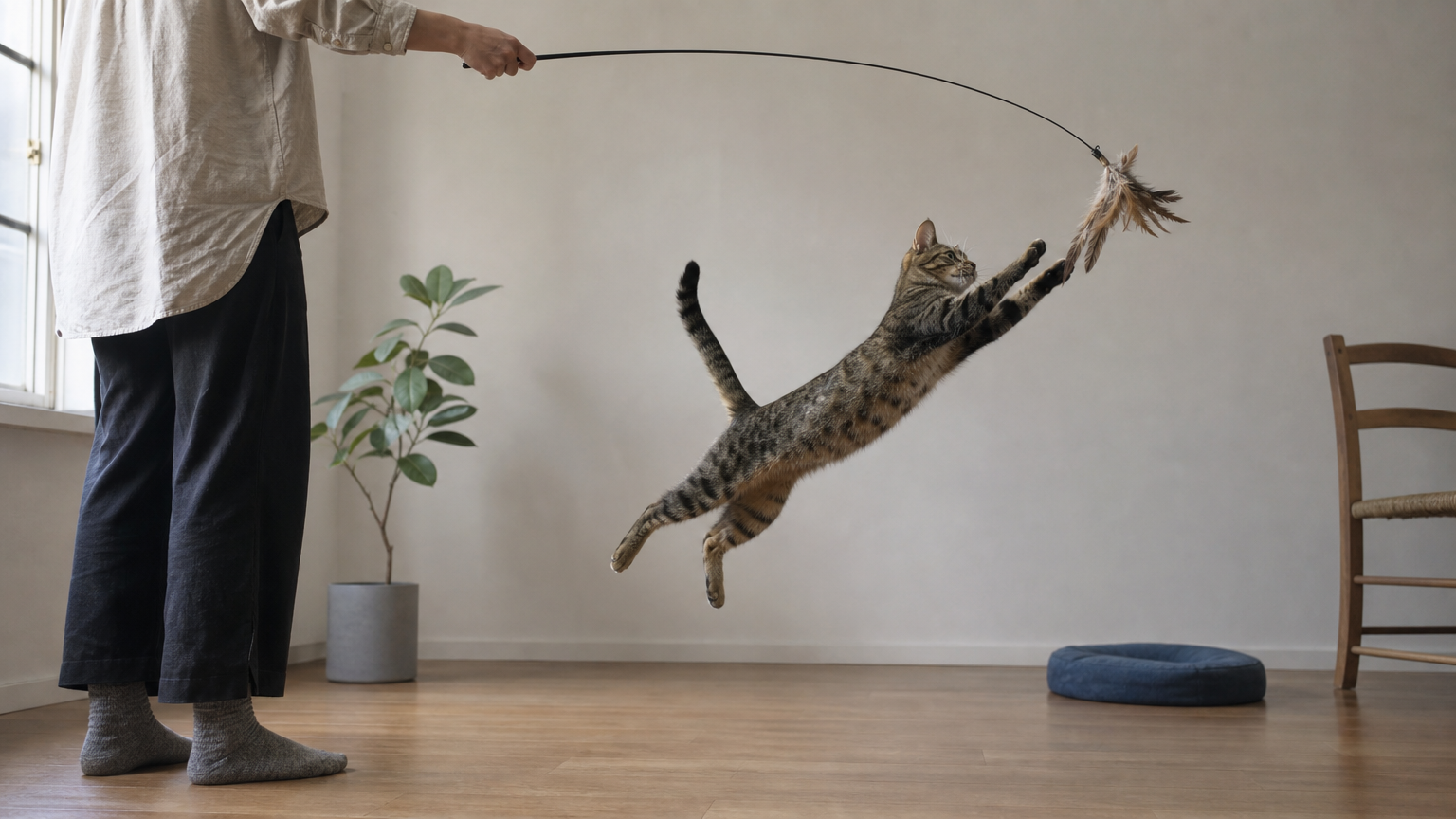
An interactive wand toy pairs a long flexible pole with a feather, fabric strip, or fur attachment dangling from a string, and it remains the closest thing to hands-on bonding time you'll find among interactive cat toys. Unlike the automated options on this list, this one needs you at the other end of it, which is exactly why so many trainers and vets recommend it as part of a daily play routine for indoor cats rather than a set-and-forget gadget.
How it works
You hold the pole and guide the attachment across the floor, up furniture, or through the air, mimicking the erratic movement of a bird or rodent trying to escape. The best designs use a flexible fiberglass rod so the lure whips and snaps unpredictably instead of moving in a stiff, robotic arc. Swap-out attachments let you refresh the toy without buying a whole new wand once your cat wears one lure down to bare thread.
Why cats love it
Because you're controlling the movement, you can react to your cat's energy in real time, speeding up when she's locked in and slowing down to let her actually catch it. That give-and-take mimics a real hunt far better than any preset pattern.
A wand toy works because a person, not a motor, is reading the cat.
It also builds trust between the two of you, since play sessions double as bonding time in a way solo gadgets can't replicate.
Best for
This is the pick for owners who want to be part of the play, not just supply the equipment, and it suits shy or anxious cats who need a person nearby before they'll engage. It's also one of the best first toys for a new kitten, burning off excess energy through short, supervised bursts.
Price range
Basic wand toys cost $5 to $12, while premium versions with multiple swap-out attachments run $15 to $25.
7. Catnip-infused plush toy
A catnip-infused plush toy is soft, huggable, and packed with dried catnip that triggers a euphoric response in most cats, from rolling and kicking to full-on ecstatic flopping. It's less about the chase and more about giving your cat something to grab, bite, and bunny-kick, which makes it a natural companion to the more motion-heavy interactive cat toys on this list rather than a replacement for them.
How it works
The plush shell holds a pouch or lining of dried catnip, sometimes refillable through a zipper or velcro seam once the scent fades. Your cat sniffs it out, rubs against it, then usually escalates into kicking, biting, or wrestling the toy between her back paws. Some versions add crinkle material or a rattle inside to layer in extra sensory feedback beyond just the scent.
Why cats love it
Catnip triggers a response tied to a compound called nepetalactone, and roughly 50 to 70% of cats inherit the sensitivity to it. For those cats, the reaction is instant and dramatic, and the plush shape gives them something physical to direct that burst of energy at.
Catnip doesn't teach a cat to play. It just flips the switch that was already there.
That's why it pairs so well with a wand or motion toy, since a catnip-charged cat is often more willing to chase afterward.
Best for
This toy suits cats who respond well to catnip and need a physical outlet for kicking and biting rather than chasing. It's also a good pick for solo play, since it doesn't require batteries, sensors, or a person on the other end.
Price range
Catnip plush toys are among the cheapest options here, typically $5 to $15 depending on size and whether the catnip pouch is refillable.
8. Ball track spinner toy
A ball track spinner toy is a circular or oval track with a lightweight ball trapped inside a groove, and your cat bats it around the loop instead of chasing it across the floor. It's a low-maintenance entry among interactive cat toys, since there are no batteries, sensors, or apps involved, just a track and a ball that never actually escapes.
How it works
Gravity and momentum do most of the work here. Your cat swats the ball, it circles the track, and the raised edges keep it from flying under the couch. Some tracks stack two or three levels so multiple balls move independently, and a few models include a center post with a feather or scratch pad attached for extra engagement. There's nothing to charge and nothing to break beyond the occasional cracked track piece from an especially enthusiastic paw.
Why cats love it
The ball is always just out of reach, circling the loop again the instant it's batted, which keeps a cat pawing at it far longer than a toy that stops moving after one hit.
A toy that resets itself after every swat never gives a cat a reason to stop.
The enclosed track also means the ball can't be lost under furniture, so play sessions don't end early just because the toy rolled somewhere your cat can't follow.
Best for
This one suits solo players who like batting and swatting more than full-body chasing, and it works well for kittens still building coordination. It's also a smart choice for households worried about small parts, since the ball never fully leaves the track.
Price range
Basic single-level ball track spinners run $8 to $15, while multi-tier towers with added features like scratch pads or feathers land closer to $20 to $30.
9. AI-powered smart cat toy
An AI-powered smart cat toy uses onboard sensors and machine learning to adjust its movement based on how your cat actually plays, rather than looping through the same fixed pattern every session. It's the newest category among interactive cat toys, and it's quickly becoming a favorite for owners who want something that genuinely learns their cat's habits instead of just running on a timer. Pet Shop Hero carries a line of pet AI products built around exactly this kind of adaptive play.
How it works
Cameras or motion sensors track your cat's speed, pounce timing, and preferred play zones, then the toy adjusts its own movement to keep pace. Some models connect to an app, letting you check play stats, set active hours, or trigger a manual play session remotely from your phone. Battery life varies by model, but most USB rechargeable pet gadgets run for days between charges thanks to sleep modes that kick in when no cat is nearby.
Why cats love it
Because the toy adapts instead of repeating, cats stay engaged far longer than with a toy running a fixed loop. A cat that gets faster gets a faster toy in return, and one that slows down gets a break to reset interest.
A toy that learns your cat's habits stays interesting long after a scripted one gets ignored.
Best for
This pick suits tech-comfortable owners who want data on their cat's activity, plus smart, high-energy cats who get bored fast with predictable toys. It's also a strong option for multi-pet households where an app lets you track which cat is actually using the toy.
Price range
AI-powered smart cat toys typically cost more than mechanical options, running $40 to $90 depending on sensor quality and app features included.
10. Cat activity tunnel
A cat activity tunnel is a collapsible fabric or plastic tube your cat can dash through, hide in, and ambush toys or housemates from. It's a low-tech entry among interactive cat toys, but the appeal runs deep, since tunnels tap into a cat's instinct to seek enclosed spaces for both stalking and safety.
How it works
Most tunnels fold flat for storage and pop open into a single tube or a branching design with multiple exits and peek holes. Crinkle material lining the inside adds sound feedback with every movement, which keeps solo cats engaged even without a toy involved. Some versions include a dangling ball or feather at one entrance, giving your cat something to swat at the moment she pokes her head out. There's no battery or sensor here, just fabric shaped to invite exploration.
Why cats love it
Enclosed spaces feel safe to a cat, and a tunnel lets her stalk from cover the way she would in tall grass outdoors. The crinkle sound and multiple exits turn a simple tube into a genuine game, especially in a multi-cat household where one cat ambushes another from a side opening.
A cat doesn't need a gadget to play. Sometimes a hiding spot with two exits is enough.
Best for
This toy suits cats who love hiding, pouncing from cover, or racing through the house at full speed. It's also one of the better interactive toys cat owners can pair with a wand toy, since dragging a feather past the tunnel opening almost guarantees a full-speed ambush.
Price range
Single-tube tunnels start around $10 to $18, while multi-exit branching designs with crinkle lining run $20 to $35.
11. Ripple rug activity mat
A ripple rug activity mat is a fabric puzzle mat made of layered folds and tunnels that your cat can burrow through, bat at, or hide small toys inside. It's one of the more textured interactive cat toys on this list, built less around motion and more around the layers of fabric a cat can dig through, nose into, and vanish beneath.
How it works
The mat unfolds into a series of raised ripples and hidden pockets, usually made from fleece or a similar soft fabric that holds its shape without stiffening. You tuck treats, catnip, or small toys into the folds, and your cat has to paw, dig, or nose through the layers to find them. Most designs fold flat for storage and pop back into shape without needing any setup beyond a shake. There's no battery, sensor, or app involved, just fabric shaped to reward digging.
Why cats love it
Digging through folded fabric taps into the same foraging instinct a puzzle feeder uses, except here the reward can be a toy, a treat, or nothing at all beyond the texture itself. Cats who like to burrow under blankets or dig through laundry baskets tend to take to a ripple mat immediately.
A cat that loves digging through your closet doesn't need a reason. It just needs somewhere better to dig.
Best for
This mat suits cats who paw and dig more than they chase, plus kittens still building confidence around new textures. It also works well layered with catnip or a small robotic mouse tucked inside a fold, giving the mat a reason to hold attention beyond the first sniff.
Price range
Ripple rug mats typically run $15 to $25, depending on size and the number of folded layers included.
12. Flapping bird kicker toy
A flapping bird kicker toy is a plush, bird-shaped toy built to be grabbed with the front paws and shredded with the back legs in that classic bunny-kick motion. Most versions add a battery-powered wing that flaps on a timer or motion trigger, which rounds out the last spot on our list of interactive cat toys with a pick built entirely around full-body wrestling rather than chasing.
How it works
A motorized wing mechanism flaps at intervals, either on a fixed timer or triggered by a touch or motion sensor built into the body. Your cat pins the plush with her front paws, then kicks with her hind legs the way she would to subdue actual prey. Some models add a chirping sound chip or crinkle material to layer in extra sensory feedback, and most run on replaceable or rechargeable batteries tucked inside a reinforced pouch that can survive repeated bites.
Why cats love it
The flapping wing mimics a bird struggling to break free, which triggers the exact kill-bite-and-kick sequence a real hunt would demand. Unlike a rigid plush that just sits there, the movement keeps a cat locked into the fight instead of losing interest after one bite.
A toy that fights back gets kicked a lot harder than one that just lies there.
That combination of motion and grip makes it one of the more physically satisfying interactive toys for cat owners can offer without needing to hold a wand themselves.
Best for
This toy suits cats who bunny-kick their existing plush toys into shreds, plus kittens learning to coordinate front-paw grabs with back-leg kicks. It also works well for cats who play rough and need something sturdy enough to absorb full-force attacks.
Price range
Flapping bird kicker toys typically cost $12 to $25, with pricier models adding sound chips and rechargeable batteries over disposable ones.
Finding the right toy for your cat's play style
No single toy on this list fixes boredom on its own. Pouncers need motion, diggers need texture, and food-driven cats need a puzzle worth solving. Watch how your cat already plays with a paper bag or a dropped bottle cap before you buy anything, since that instinct tells you more than any product description will.
Start with one or two picks that match what you've already observed, then rotate them weekly so nothing gets stale. Combining categories works best: pair a motion toy with a catnip plush, or a puzzle feeder with a tunnel, so your cat gets both mental and physical outlets in the same day.
An interactive cat toy only earns its keep if your cat actually reaches for it, and that's exactly what we built our own line around. Browse our interactive cat toys for indoor cats at Pet Shop Hero and let your cat pick the winner.